

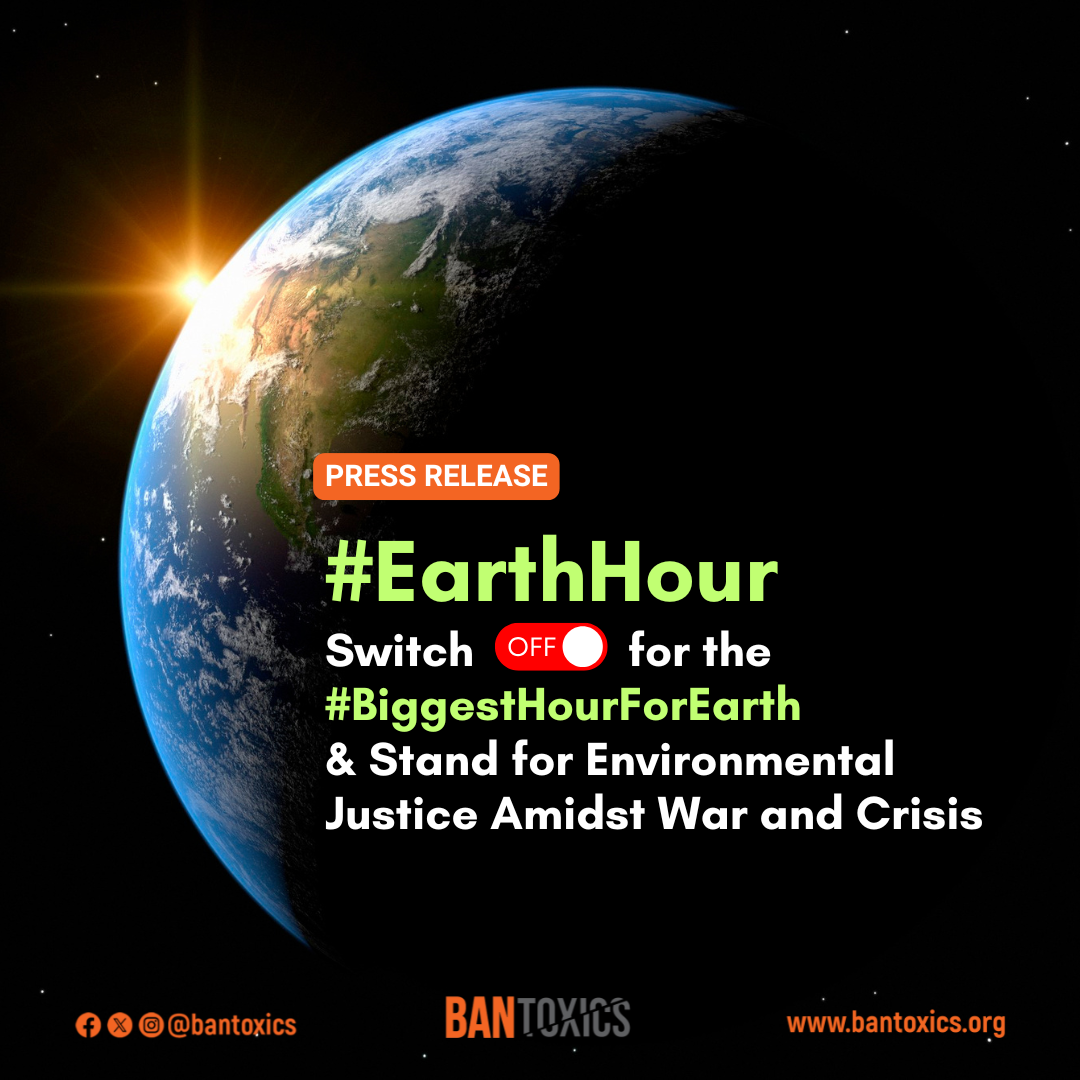
MARKING the 20th year of #EarthHour, environmental NGO BAN Toxics calls on every Filipino to move beyond the symbolic 60-minute switch-off, embrace energy conservation as a daily commitment, and recognize that conserving energy is more than a symbolic global movement—it is an urgent necessity in the face of a deepening energy crisis and environmental harm.
World Meteorological Organization’s State of the Global Climate 2025 report confirms that 2015–2025 are the hottest 11 years on record, with 2025 ranking as the second or third hottest year at about 1.43 °C above the 1850–1900 average. The oceans continue to warm and absorb carbon dioxide emissions, about eighteen times the annual human energy use each year over the past two decades. The UN Secretary-General warns the climate is in an emergency, with every key indicator flashing red.
“We observe #EarthHour annually to remind us of our shared responsibility to protect the planet. Achieving this requires urgent, collective action across all sectors, coupled with greater accountability from corporations and governments. But how can we succeed while ongoing wars continue to intensify the environmental crisis?” said Thony Dizon, Advocacy and Campaign Officer of BAN Toxics.
According to the Conflict and Environment Observatory, militaries are responsible for an estimated 5.5% of global greenhouse gas emissions. This figure remains uncertain due to the limited reporting to the UN Framework Convention on Climate Change, as military emissions are largely exempt from disclosure. With military spending on the rise, the Stockholm International Peace Research Institute reports a 9.4% increase in 2024, these emissions are likely to grow further.
Based on analysis by the Climate and Community Institute, total greenhouse gas emissions from the first 14 days of the war against Iran amounted to more than 5 million tonnes of carbon dioxide—equivalent to the annual emissions of 1.1 million gas-powered cars—and represent over $1.3 billion in climate damage.
“War carries a hidden climate cost. It destroys ecosystems, infrastructure, and livelihoods, leaving polluted air, contaminated soil, and unsafe water long after the conflict ends. From Ukraine to Palestine, Lebanon, Sudan, Venezuela, and Iran, the devastation of war ripples far beyond battle zones, affecting civilians and ecosystems in profound and lasting ways,” Dizon explained.
The crisis caused by the US–Israel war on Iran has disrupted global energy supply chains, with attacks on energy infrastructure and blockades of the Strait of Hormuz reducing oil flows and driving price volatility. As a result, the Philippines, which imports roughly 98% of its oil from the Middle East based on the Department of Energy, is bearing the impact of these global supply shocks, with diesel prices surging past 120 pesos per liter.
In response, President Marcos Jr. signed Executive Order 110, declaring a national energy emergency. However, BAN Toxics emphasizes that the government must not shift the burden onto the public while leaving the long-standing structural flaws of the privatized energy sector unaddressed.
“In this time of war, climate change, and crisis, we must conserve energy and natural resources through energy-efficient practices, reduced consumption, and resist actions that harm the environment. We urge the government to ensure a people-centered response to the energy crisis by regulating fuel prices, suspending taxes, and providing immediate support for public transport drivers, low-income households, and other marginalized communities,” Dizon emphasized.
There are concerns that the emergency declaration could be used to fast-track corporate energy projects, without proper consultation or environmental safeguards, putting communities and ecosystems at risk and locking in profit-driven energy policies that fail to deliver affordable, reliable power.
“This #EarthHour, as we switch off our lights for the #BiggestHourForEarth, let us take a stand against environmental destruction and the social injustices fueled by war. Conservation is crucial, but environmental justice demands accountability, systemic reform, and the protection of communities caught in conflict and crisis, affirming everyone’s right to a clean, healthy, and sustainable environment,” Dizon said.